 Jahan Analysis
Did Ibn Khaldun Predict Their Fall?
 Watch the film42:06
In this film
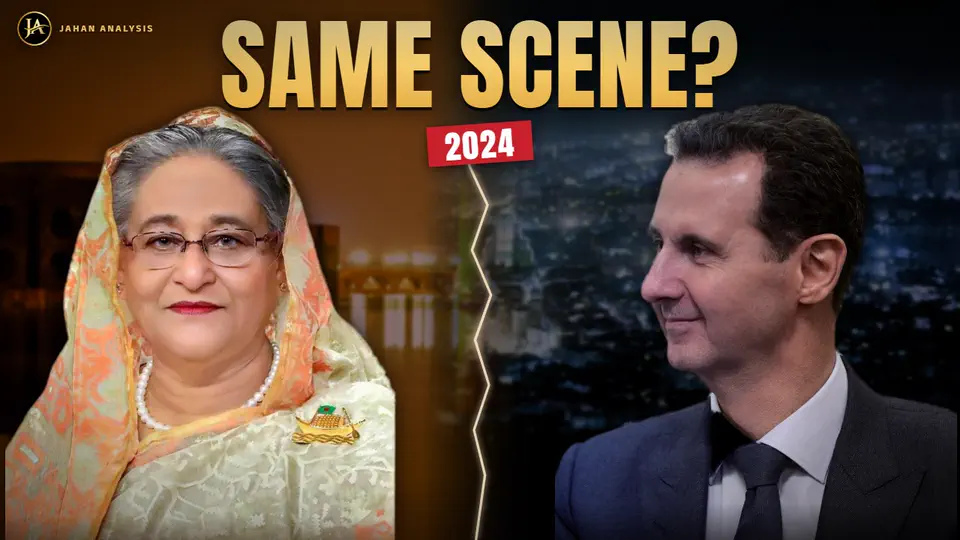
In 2024, within months of each other, Bangladesh's Sheikh Hasina and Syria's Bashar al-Assad fell. All that power, and yet on the last day their own armies did not stand by them.
Nearly 650 years ago, Ibn Khaldun's Muqaddimah asked why mighty rulers one day fall. I test his answer, asabiyya, the bond that holds a group together, against Dhaka and Damascus: where it fits, where it doesn't, and where he went wrong. Then Timur's tent, and my own reckoning: six signals and one forecast, to be settled in June 2027.
Chapters and key points
- Intro
In 2024, within months of each other, Sheikh Hasina and Bashar al-Assad lost power, and on the last day their own armies did not stand by them. One question: why do mighty rulers one day fall?
- Chapter 1: The Man Who Saw It Himself
Ibn Khaldun's own life: parents lost to the plague, top posts at court and a prison cell. Then, in 1375, he left politics for a remote fortress in today's Algeria, and there, in five months, he wrote the first draft of the Muqaddimah, finished in 1377. He wrote about the fall of power from what he had seen himself.
- Chapter 2: The Three Friends' Shop
A story of three friends and a shop explains the book's key idea, asabiyya: group solidarity. And the rule of decline: a ruler breaks the very foundation that brought him to power. Asabiyya is not blood; it is born of a shared struggle.
- Chapter 3: The First Mistake, Glory Alone
Once in power, a ruler wants the glory for himself and pushes his old companions aside: Assad's cousin Rami Makhlouf stripped of his fortune, and in Dhaka, old comrades and allies removed one by one.
- Chapter 4: Hired Hands
Ibn Khaldun: "Few people will hire themselves out to embrace death." Assad's soldiers paid forty dollars a month, and a regime gone in eleven days; in Dhaka in August 2024, an army that would not fire on the crowds.
- Chapter 5: The Money Trap
Ibn Khaldun's vicious circle of taxes, the idea Ronald Reagan quoted. Syria's currency collapse and highway extortion; Bangladesh's highest inflation in thirteen years, bad loans, money laundering, and the young losing hope.
- Chapter 6: The Curtain
As power ages, a curtain of flattery falls before the ruler's eyes. By the UN's account, warnings reached the top in early July 2024 and went unheeded; then the press conference of July 14th, and the fall twenty-two days later.
- Chapter 7: The Wick's Last Flare
Like a wick that flares just before it goes out, a state shows its greatest glitter right before the fall: Assad welcomed back into the Arab League, and in Dhaka, grand projects and a declaration in Parliament that no power in this world could topple the government.
- Chapter 8: The Final Push
A rotten state still needs a final push from a united force: HTS in Syria, as Assad's foreign props fell away; in Bangladesh, a new asabiyya born in the streets among strangers who fought side by side.
- Chapter 9: Where Ibn Khaldun Was Wrong
Four flaws in his theory: dynasties lasting no more than 120 years (yet by his own account the Fatimids lasted about 280), racist remarks about Black people, no place for women, and in a modern democracy, elections are the normal way power changes.
- Chapter 10: In Timur's Tent
1401: Ibn Khaldun climbs down the walls of Damascus into Timur's tent, and, fearing for his life, states his own theory wrapped in flattery, as he later admitted in his autobiography. He himself became the proof that fear breeds flattery.
- Chapter 11: My Forecast
Six signals to test any government, and one forecast: by June 30th, 2027, the Eighteenth Amendment to the constitution passes, with a chance of at least six in ten. The signals get their reckoning in June 2027.
This film's forecast
Test yourself
8 questions, all answered in the film. Pick an answer and you'll see at once whether it's right.
1. Where did Ibn Khaldun write the first draft of the Muqaddimah?
He took refuge there in 1375, after leaving politics; the five months of writing ended in 1377. The book was only the introduction to his history of the world, and that introduction became a landmark of world thought. In the film at 4:54
2. What does "asabiyya", the Muqaddimah's key idea, mean?
Ibn Khaldun himself wrote that lineage is imaginary; the real bond comes from sharing hardship and fighting for survival together. In the film at 7:07
3. Whose fortune did Bashar al-Assad's government seize in 2020?
He controlled Syria's biggest telecom company and much of the economy. Ibn Khaldun wrote that in a dynasty's last stage, the ruler swallows the wealth of his own powerful courtiers. In the film at 9:50
4. Which of these lines is Ibn Khaldun's?
His warning about paid soldiers; Assad's troops were earning forty dollars a month. The other two are Machiavelli's, from Book 2 of the series. In the film at 13:08
5. Which US president quoted Ibn Khaldun's idea about taxes about ten times?
When a state is young, taxes are light and revenue is high; when it grows old, tax piles on tax, and revenue falls. In the film at 17:33
6. What does Ibn Khaldun's image of the "last flare of the wick" mean?
Like Assad's warm return to the Arab League in 2023; he fell a year and a half later. In the film at 25:20
7. Which of Ibn Khaldun's claims fails by his own example?
He himself wrote that the Fatimid caliphate lasted about 280 years. In the film at 30:34
8. What did Ibn Khaldun do in Timur's tent in 1401?
He admitted it later in his autobiography. He himself became the proof that fear breeds flattery. In the film at 32:46
Sources
PDFEvery source in one PDFFree · 18 sources, with links · print it if you like- UN OHCHR report, 2024
- Reuters, Assad's final hours
- Reuters, Assad's army collapse
- Amnesty, Saydnaya prison
- Rami Makhlouf's assets seized
- Assad back in the Arab League
12 more sources
- White paper, money laundering
- Inflation, 9.73%
- Bad loans
- Hasina's ex-aide, Tk 400 crore
- Enforced disappearances commission
- The 2018 election, TIB
- Party appointments (The Daily Star)
- Reagan quoting Ibn Khaldun
- Zuckerberg's reading list
- Toynbee and Ibn Khaldun
- Ibn Khaldun's autobiography (Arabic), meeting Timur
- The Arabic original
Sheikh Hasina's photo in The Muqaddimah thumbnail: Press Information Department (PID), Bangladesh, Public domain, Wikimedia Commons; cut out and placed on a new background.

Bashar al-Assad's photo in The Muqaddimah thumbnail: Presidential Press and Information Office of Russia (Kremlin.ru), CC BY 4.0, Wikimedia Commons; cut out, mirrored and placed on a new background.

The left background of The Muqaddimah thumbnail, the National Assembly of Bangladesh at night: Syedsazzadulhoque, CC BY-SA 4.0, Wikimedia Commons; blurred and colour-graded.

The right background of The Muqaddimah thumbnail, Damascus at night from Mount Qasioun: Mohamadmahfod, CC BY-SA 4.0, Wikimedia Commons; blurred and colour-graded.
